Sample Set of Learning Assessments (Set 1)
These are sample individual learning assessments of the approximate type and difficulty that you will encounter. They represent the LAs for the first set of LAs.
Decompose a computational problem into smaller sub-problems amendable to implementation with functions.
Consider the following image that contains three “squared circles”.
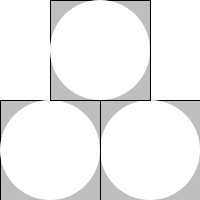
Each white circle is in a 100x100 grey box with a black outline. There are two blue boxes in the bottom row and one in the top row, centered above the other two.
Make sure to use decomposition to break down this image into meaningful sub-images. Your code should reflect the structure of this image.
Hint: to achieve the outline effect, overlay two squares, one with 'outline and the other with 'solid.
Make sure to check the results in DrRacket!
Take a concrete implementation in Racket and create a new function that generalizes the behavior.
As you may recall in building snowmen, we found it useful to be able to create hats for the snowmen. A hat consists of three parts: a box, a brim, and a ribbon. The brim is at the bottom. The ribbon appears to be on the box, directly above the brim, although we will create it by stacking a rectangle over the box.
We’ve decided on a 50x50 grey hat with a purple ribbon. We’ve decided that brims will always be 5 units high and that ribbons will take 1/5 the height of the box. Rather than doing the calculations by hand, we’ll make Racket do the computations.
(above (rectangle (* 50 1/2) (* (- 50 5) 4/5) "solid" "grey")
       (rectangle (* 50 1/2) (* (- 50 5) 1/5) 192 "purple")
       (rectangle 50 5 "solid" "grey"))
Write a procedure, colorful-hat, that generalizes this approach
by taking the width, height, hat color, and ribbon color as parameters
and producing an appropriate image as output.
Trace the execution of a Racket program using a substitutive model of computation.
Consider the following procedure definitions.
(define f
  (lambda (x y)
    (string-append x "-" (string-reverse x))))

(define g
  (lambda (x y)
    (string-append (f x x) " " (f y x)))))

(define h
  (lambda (x y)
    (string-append (g x y) "&" (g y x))))
Using our mental/substitutive model of computation for Racket programs, give a step-by-step evaluation of the following Racket expression.
(h "howdy" "y'all")
Note: You may want to confirm your answer in DrRacket.
Note: Some of you may find that Dr.Racket lacks a string-reverse.
Here’s an implementation: (define string-reverse (lambda (str)
(list->string (reverse (string->list str))))). You do not need
to trace the running of string-reverse.
Express basic computations over primitive values and their associated standard library functions.
As you may recall, Racket uses the Unicode collating sequence to assign a number to each character (or vice versa). Fortunately, Unicode puts the standard American letters (A, B, C, …, Z) in order, perhaps because it draws about the ASCII standard.
Write two procedures, uc->num and num->uc that convert uppercase
letters to numbers and back again. Both should use the “standard”
numbering system for letters in which “A” is letter number 1, “B”
is letter number 2, … “Z” is letter number 26. That is, they should
not use the collating sequence number.
You should be able to write both procedures without knowing the
collating sequence number for #\A. (You can, of course, write
code that asks for it.)
You may assume that the inputs are “correct”. That is, uc->num will
only receive uppercase letters and num->uc will only receive numbers
in the range 1 through 26, inclusive.
> (uc->num #\A)
1
> (uc->num #\E)
5
> (uc->num #\I)
9
> (uc->num #\O)
15
> (uc->num #\U)
21
> (num->uc 5)
#\E
> (num->uc 10)
#\J
> (num->uc 15)
#\O
> (num->uc 20)
#\T
> (num->uc 25)
#\Y
Utilize boolean expressions and values in a program to produce conditional behavior.
As you know, we often associate words with students’ standing in College. Those who have completed fewer than four terms are “freshlings”, those who have completed between four and seven terms (inclusive) are “wise fools”, those who have completed between eight and eleven terms (inclusive) are “subordinates”, and those who have completed at least twelve terms are “elders”.
Write a procedure, (status terms), that, given the number of
terms a student has completed as input, produces a string that
describes the student using the terms above.
Write and structure program code in ways that makes it easier to understand.
Although it is early in the semester, you have already started to lear some basic approaches to making your code more readable. Here are a few.
- Put all of the parameters to a procedure on the same line, or all on separate lines.
- Similarly, when writing an if statement, put the test, consequence, and alternate all on the same line or all on separate lines.
- Use Ctrl-i to reindent the text
- When defining a procedure, place the
lambdaand the parameters on a separate line fromdefine, and start the body on a separate linne from the lambda and the parameters. - Follow “The Zen of Booleans”: Avoid explicitly using #t and #f in expressions if you can write them more concisely with
andoror. - Avoid repeated code.
- Avoid unnecessary code.
- Choose descriptive names for variables and procedures.
a. Using those principles, as well as others you have learned, clean up the following code.
(define rab (lambda
(int
str)
(if (if (equal? #t (integer? (string->number (substring int str))))
#t #f) (string->number (substring int str))
(if (if (equal? (integer?
(string->number (substring int 0 str))) #f) #f
#t
) (string->number (substring int 0
str)) #f))))
b. In English, describe what rab does.
Explain best practices for solving problems in a collaborative setting.
Consider the following dialogue between driver and navigator.
Driver: I’m not quite sure what to do here. What do you think?
Navigator: Really? It’s easy. You just need a call to map. Type “map square list 1 2 3”.
Driver: Ok. Like this?
Navigator: No! You need a paren before map. And just type the single quote for the list. You spell it “sqr” not “square”.
Navigator: Don’t put another single quote at the end of the list!
Navigator: Let’s start again. Open parenthesis. The word “map”. A space. The word “ess queue are”. Another space. A tick mark. Another open parenthesis. The numeral 1. A space. The numeral 2. A space. The numeral 3. A close parenthesis. Another close parenthesis.
Driver: What else do you think we should do?
Navigator: Press the return key. Duh.
a. What went well in this conversation?
b. What went poorly?
c. How could the navigator have been a better partner?